

A high, broad forehead was considered the epitome of beauty for European noblewomen during the Late Medieval and Early Renaissance eras. Of course, times have changed—and so have beauty standards. Now, women whose hairline is positioned back toward mid-scalp are likely to feel self-conscious and frustrated about their appearance. Attempts to disguise a high forehead with bangs don’t always work—particularly when the hairline is greatly recessed, in which case bangs can call attention to it.
Fortunately, a hairline-lowering hair transplant could be the answer for women who want a permanent solution that increases self-esteem and provides a wider range of hairstyle options.
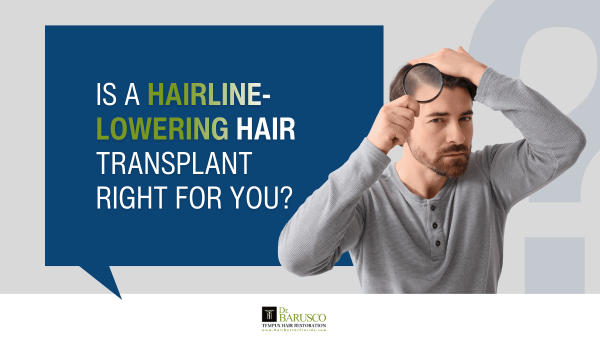
While women often seek this procedure to reduce the appearance of a high forehead, men frequently pursue hairline restoration to address genetic recession at the temples or a gradually receding frontal hairline. In both cases, the goal is the same: restoring a balanced, natural-looking hairline that complements the face.
But first, let’s be clear about this type of procedure. It is not forehead reduction surgery, which involves removing excess skin and moving the scalp forward. This procedure is also known as hairline lowering, which can cause confusion.
In a hairline-lowering hair transplant, hair grafts are harvested from the donor site of the scalp and implanted to create a new, lower hairline that reduces the vertical size of the forehead, thereby bringing the face into better proportion. Hair transplantation offers a more controlled, customizable approach and avoids the linear scar associated with forehead reduction surgery. It is also more versatile for filling in specifically thin areas, such as the temples.
Reasons Why a Hair-lowering Hair Transplant May Be the Right Solution
Addressing a naturally high hairline — Many individuals, particularly women, have a congenitally high hairline or a large forehead. For women, the ideal hairline is approximately 6 to 6.5 centimeters above the eyebrows. For men, it is typically 7 to 7.5 centimeters, although male hairline design must also account for natural temple recession and future hair loss patterns. The transplant moves the hairline down to improve facial harmony.
Treating traction alopecia — This type of permanent hair loss is often caused by chronic, tight hairstyles (e.g., braids, high ponytails) that pull the hair back and/or create constant tension on the scalp (such as hair weaves)—which eventually destroy hair follicles. Damage occurs over time, so it typically isn’t noticed until hair loss is significant. Our blog post—“Is a Hair Transplant a Solution for Traction Alopecia”—covers this topic in detail.
Correcting the effect of a brow lift —If a previous forehead lift or brow lift has unintentionally raised the hairline too high, a transplant can be used to visually lower it back to a more desirable position. Although the terms “forehead lift” and “brow lift” are often used interchangeably, a forehead lift focuses more on smoothing the entire forehead surface, whereas a brow lift specifically elevates the brows themselves.
Dr. Marco Barusco is Founder and Chief Medical Officer at Tempus Hair Restoration, and President of the American Academy of Cosmetic Surgery (AACS). He took a question from a viewer of his YouTube channel, Hair Loss Medical Advice, who had recently undergone a brow lift. The viewer sent a photo of herself, showing that her hairline was set far back on her scalp. She had asked if another procedure to surgically reduce her hairline would be possible.
In the video, Dr. Barusco replied that because of her brow lift, the remaining elasticity she has remaining in her forehead tissues would be unlikely to support forehead reduction surgery. However, a hairline-lowering hair transplant could be a good option for her particular situation.
The Advantages of a Hairline-lowering Hair Transplant as Opposed to Forehead Reduction Surgery
Hairline-lowering hair transplants offer significant advantages over forehead reduction surgery—primarily by providing a more natural-looking, scar-free and customizable result with faster recovery. Unlike surgical advancement—which cuts skin and leaves a visible scar—transplants use the patient’s own hair, allowing for better density, shape customization and no (or minimal) visible scarring.
No visible scarring — While forehead reduction leaves a long, linear scar across the hairline, FUE (Follicular Unit Extraction) transplants leave tiny, nearly invisible dot scars that are easily concealed by hair as it grows.
More natural-appearing results — Transplants allow surgeons to meticulously place hair follicles at appropriate angles, creating a softer, more natural hairline compared to the potential straight-line harshness of a pulled-down scalp.
Highly customizable — Hair transplants enable precise control over the shape of the hairline—including the ability to round, flatten, or customize the density of the new hair—which is difficult to achieve with tissue removal.
Less recovery time — The recovery period for hair transplants is typically 2–5 days, whereas forehead reduction surgery can require 10–14 days of downtime.
Suitable for more candidates — This method is ideal for patients with poor scalp laxity or those whose forehead skin cannot be easily stretched, making them unsuitable for forehead reduction surgery.
Procedures That Can be Used for a Hairline-lowering Hair Transplant
Follicular Unit Excision (FUE) — In this procedure, follicular units (hair grafts) in groupings of one, two or three hairs are individually extracted from the back of the head (donor area) using small circular punch blades instead of a scalpel. The grafts are then transplanted to the thinning or balding areas of the scalp. Once the desired number of grafts are obtained, the donor sites are left to heal without suturing. The resulting scars are not readily visible and are easily concealed even by very short hair.
Follicular Unit Transplantation (FUT) — Also known as the “strip” method, the FUT procedure has undergone refinements over the years so that the only evidence is a pencil-line linear scar easily concealed by hair—even at a shorter length. Dr. Barusco typically recommends the FUT for traction alopecia rather than the FUE, which tends to decrease the hair volume of the donor area.
Why Experience, Skill and a Strong Aesthetic Sense Matter in a Hairline-lowering Hair Transplant
One of the most critical and irreversible aspects of a hair transplant is hairline design. To achieve the best possible result in any type of hair transplant, the surgeon must do the following:
- Create a natural-looking hairline by building subtle irregularity into the hairline (not a straight, artificial line).
- Balance facial proportions.
- Consider ethnic hair characteristics.
Our blog post—“Why Experience and Skill Matter More Than Technology in Hair Transplants” —covers this topic in greater detail.
Learn Your Options and Choose Your Surgeon Wisely
Looks really do count! If you feel that people see your high forehead first, if you’re tired of wearing hairstyles to conceal it instead of a style you’d really like, or otherwise just wished it wasn’t so prominent, a hairline-lowering hair transplant may be the right option! Taking the first step to see if you’re a good candidate can also be the first step to boosting your self-confidence and living your best life!
Ultimately, choose your hair transplant surgeon based on experience, results and integrity. Dr. Barusco’s long list of accomplishments, his notable artistic ability and his successful surgical team make Tempus Hair Restoration a renowned practice. Contact us to schedule your free virtual consultation. Dr. Barusco conducts every consultation himself, giving you the opportunity to learn your options in the comfort of your home – or any location, on any internet-enabled device.
Dr. Barusco conducts consultations in English, Spanish and Portuguese. For your greater convenience, Tempus Hair Restoration offers a two-night complimentary hotel stay to out-of-town clients who travel 100 miles or more to our Port Orange, Florida, surgical center. No matter how far the distance, we welcome the opportunity to help you on your hair restoration journey!